Scheduling · 4 min read
Building the week
The point of the weekly roster is that it stops being a weekly job. You type each driver’s normal pattern once; after that a week is generated from it in a press, the exceptions are the only thing you touch, and publishing is what puts it on every phone at once.
The permanent schedule comes first
Schedule › Permanent schedule
One row per driver: the days they normally work, and the wave they normally go out in. That is the whole thing. It is the only real typing in scheduling and everything downstream reads it — the week generator, and the board’s fallback when a day has no wave picked.
It also shows you what you have promised: the days each person is on, so a pattern that has somebody down for six is visible while you are still typing it rather than on the morning Amazon’s limit bites.
Generating a week
Schedule
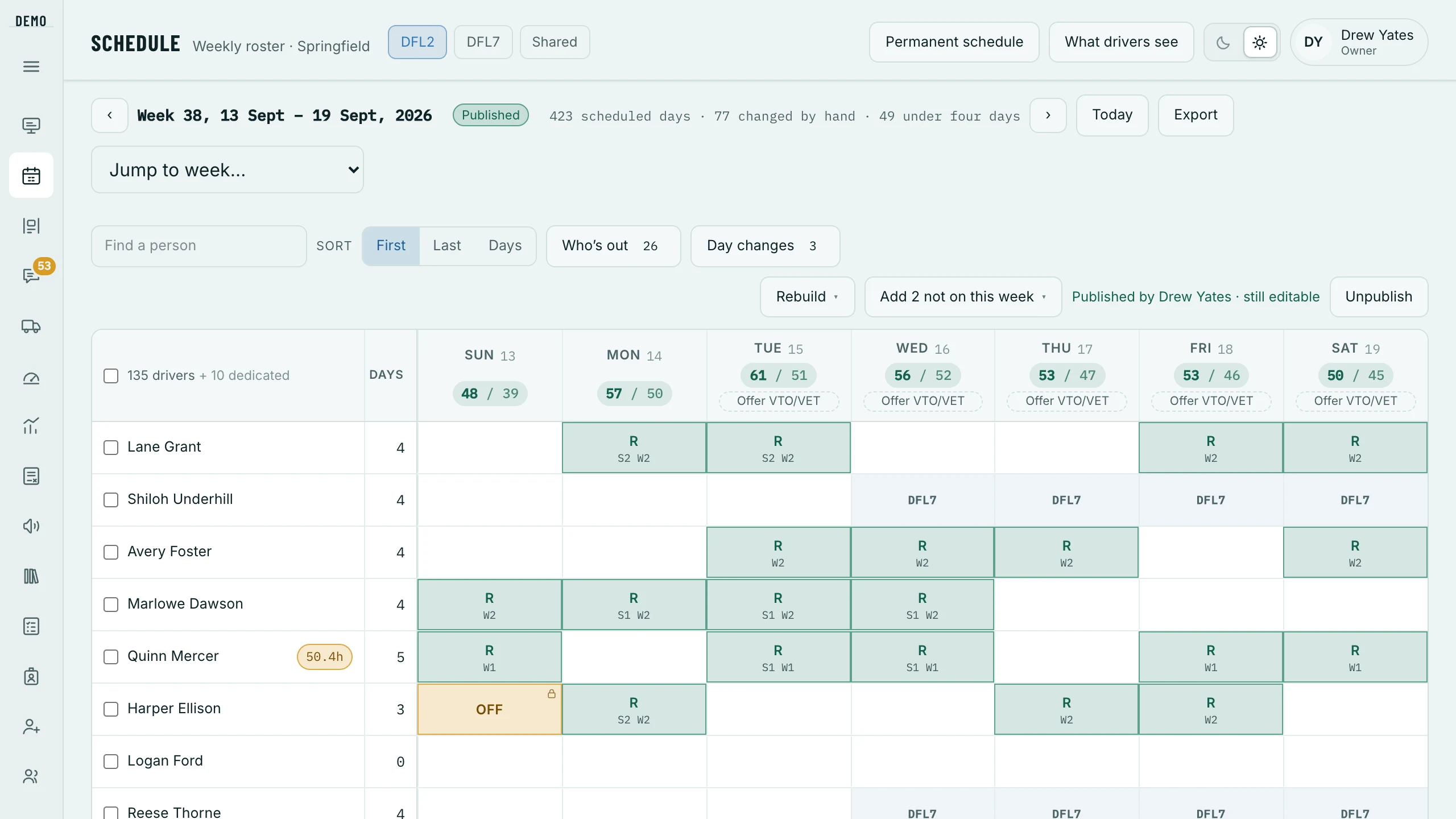
Pick the week. They start on a Sunday.
The arrows only step to weeks that exist, and stop when there are none — so an arrow that has stopped is telling you something rather than being broken.
Press Generate from pattern.
It lays out everybody’s normal days, then applies anything already recorded on top — approved time off, a suspension, a day held at your other station. It starts as a draft: only the ops team can see it.
Read it against the demand beside each day.
Each day carries Amazon’s confirmed route count, so the week tells you where it is short before anybody is short. Nursery routes and on-road trainers count — somebody has to be rostered to drive them.
Fix the exceptions.
Time off, a swap, somebody added for a day. Use Add to bring in people who are not on the week at all; the picker offers the ones under four days first, and sorts by first name, because that is how people are asked for.
Press Publish this week.
Now it is on every rostered driver’s phone. You are asked twice, with the number of people it reaches on the button, because publishing tells people when to come to work.
The rebuild menu, and which of them you can undo
Schedule › Rebuild
- Copy last week
- Last week’s roster laid over this one. The safe one — it does not throw anything away.
- Generate from pattern
- Re-lays the pattern over the week. Hand-made changes to those days go.
- Clear this week
- Empties it. Gone, and not recoverable.
- Add
- Only adds. It never removes anybody, so it is the one to reach for when a week is nearly right.
The two destructive ones are behind the menu rather than beside Publish, and they disappear once a week is published — a published week is a promise a lot of people have already read, so changing it is a deliberate act and not a mis-click.
Two stations
A person works one station on one day, and moving a day between yards is its own press rather than an edit — because their shift and wave belong to the station they were at. The emptied cell then names the other station instead of reading as a free day somebody could be called in for, which is exactly the mistake that costs you a driver at the wrong yard.
When the week is wrong on the day
Three different tools, and the difference is worth knowing:
- Day changes
- Add, drop or swap a single day — including on a week nobody has generated yet, which is the awkward case every roster has.
- Flex
- Offer extra shifts or voluntary time off to the drivers who qualify, and let them take it on their own phones instead of a group text and a race.
- The board
- Anything on the day itself. A change on the board does not rewrite the roster, because what somebody was scheduled for and what they actually worked are two different facts and you will want both later.