Everyone · 3 min read
Telling the station something
Four different ways to tell people something, and picking the wrong one is why a notice gets missed. The difference is not the words — it is whether the thing is a conversation, a notice, a rule somebody has to sign, or the one message that has to reach a phone tonight.
Which one to use
- Chat
- A conversation. The day’s channel for the drivers on the board, a desk for the office, a thread per rescue, a broadcast per station. Photos, video, documents, read receipts.
- An announcement
- A notice with an author and a date, which people read rather than reply to. This is where the weekly post and the tip of the day go.
- A policy
- A document somebody has to sign, and you can see who has not. It lives in the library and stays there.
- A guide
- Something people come back to. Also the library, but read rather than signed, and it can be aimed at the ops team only.
The thing that decides whether phones ring
Nothing rings inside your quiet hours, set on Settings › Quiet hours. A post made inside them is posted at once and its buzz is held until they end — a driver’s phone is not an appropriate place to be at midnight, and a notice they read in the morning is a notice they read.
The library
Library
Three lanes: Policies people sign, Guides everybody can read, and Ops guides only your office can reach. The shelf a document is filed on decides its audience — there is no second switch to get wrong, which matters because a guide to a screen a driver cannot open has no business in a driver’s library.
A document is written in blocks rather than typed as a page: a standfirst, numbered steps, a do-and-don’t pair, a facts table, a picture where it belongs. Publishing a new version keeps the old one, so a signature from March is still a signature against the words that were on the screen in March.
Chat, briefly
- All Ops
- Everyone in the office, in one room, pinned at the top. Nobody is added by hand.
- The day’s channel
- Everybody on the board that day — tomorrow’s opens when the shift times go out — and it closes with the day. Nobody has to be added or removed.
- Desks
- The office’s own threads — Dispatch, Fleet, HR — so a driver messages a desk rather than a person who might be off.
- A rescue thread
- Made when a rescue is assigned, carrying the meeting place and who to call.
- Broadcast
- One per station, for the notice that goes to everybody. Drivers read and react; they do not post.
- Retention
- You set how long messages are kept, and old ones are actually deleted.
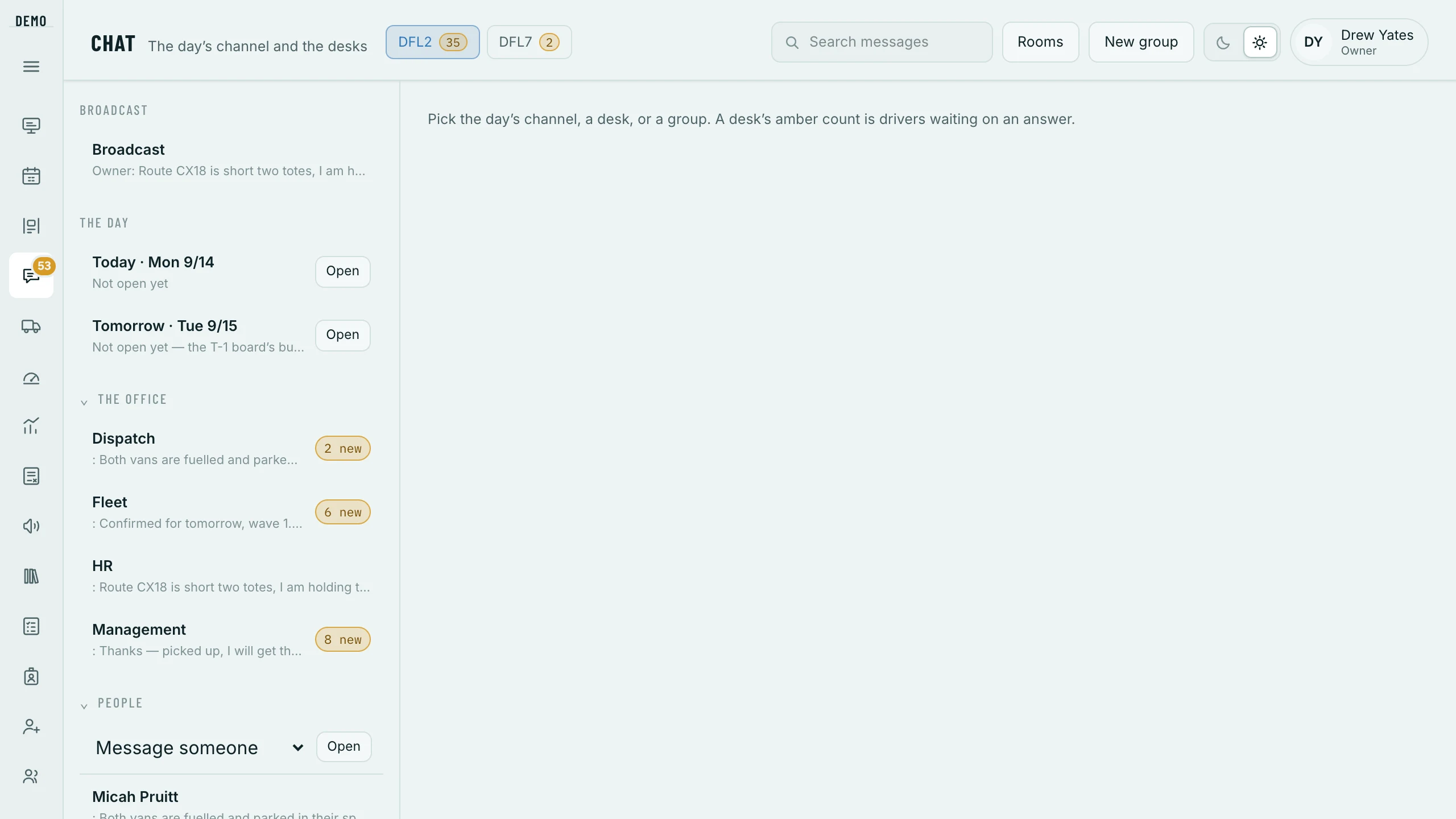
The Chat guide walks through it step by step, on a computer and on a phone.
Deliberately absent: calling. A callback request in a desk thread plus the phone on the wall is the design rather than a gap — a dispatcher’s hands are already full and a ringing app is one more thing to miss.