Dispatch · HR · 5 min read
After the route
When the route ends, two things decide how the day looks on paper: every package that came back has had its customer contacted, and every driver has clocked out of payroll. Neither Amazon nor your payroll app tells the driver in time. OpsBrio asks each driver on their own phone, the same evening, and shows the desk who has answered.
Returns a call can still fix
Amazon judges a returned package about two days later. A return counts against your scorecard unless the driver contacted the customer — or, when the customer could not be reached, Driver Support — and a call to Driver Support is accepted for a while after the package is back at the station. By the time the verdict arrives, that window has long closed. So the Cortex sync reads Amazon's own list of packages attempted and not delivered — the tracking number, the driver and the reason — all through the evening, and asks while a call still counts.
Only the reasons Amazon excuses after a contact are asked: unable to access, unable to locate, no safe location, unsafe due to a dog, customer unavailable, bad weather and a missing access code. A closed business, a cancelled order and a damaged box never are.
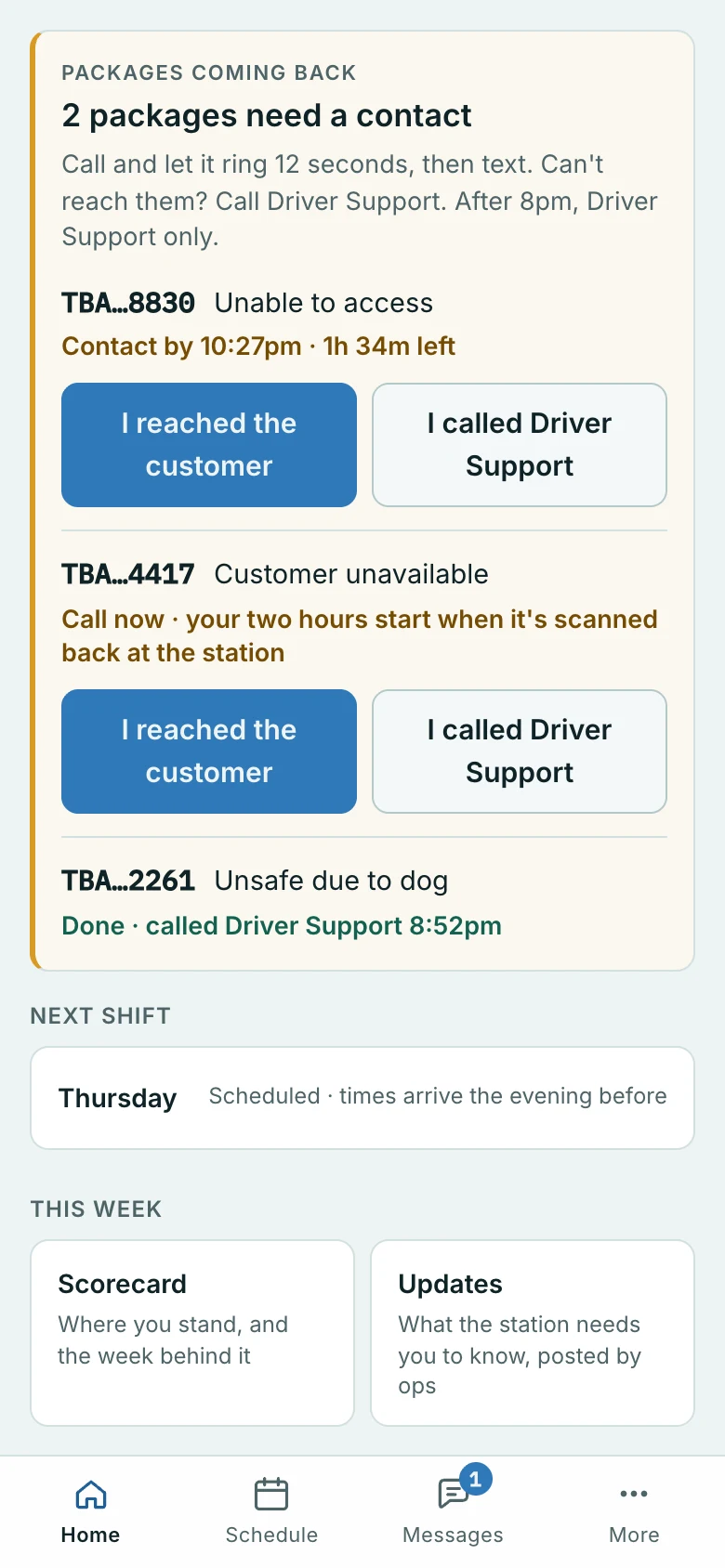
A package is attempted and not delivered. The driver's phone rings once, as soon as the sync reads it: call and text the customer now.
There is no deadline yet — the two hours start when the package is scanned back at the station.
It is scanned back at the station. A second ring names the deadline: two hours from the scan.
Amazon's list does not carry the time of the scan, so the clock starts at the sync's last look before the package showed up back — never later than Amazon's deadline, at most half an hour early.
The driver answers on Home, package by package — I reached the customer or I called Driver Support.
Every message says it: after 8pm, only a call to Driver Support counts.
Thirty minutes before the deadline, a last call — only if that package is still unanswered.
An answer stands down anything still waiting to ring. No phone rings twice inside fifteen minutes, and only today's packages ask.

What the desk sees
Dispatch › Returns
Today's board carries a strip — how many packages still need a contact, how many drivers, and when the first window closes, red in its last half hour. Dispatch › Returns lists every package in three groups: need a contact, with the driver's number and a mark for anybody with no app login, who has to be phoned; done by the driver; and a contact won't fix these — a closed business, a cancelled order, and a package brought back with no reason chosen, which counts against you and needs a word with the driver.
Two days later, Amazon's verdict sits beside each package on the same page — counted, contact compliant or excused — next to what the driver pressed. "Said done · Amazon counted it" is the line to coach from.
The clock-out
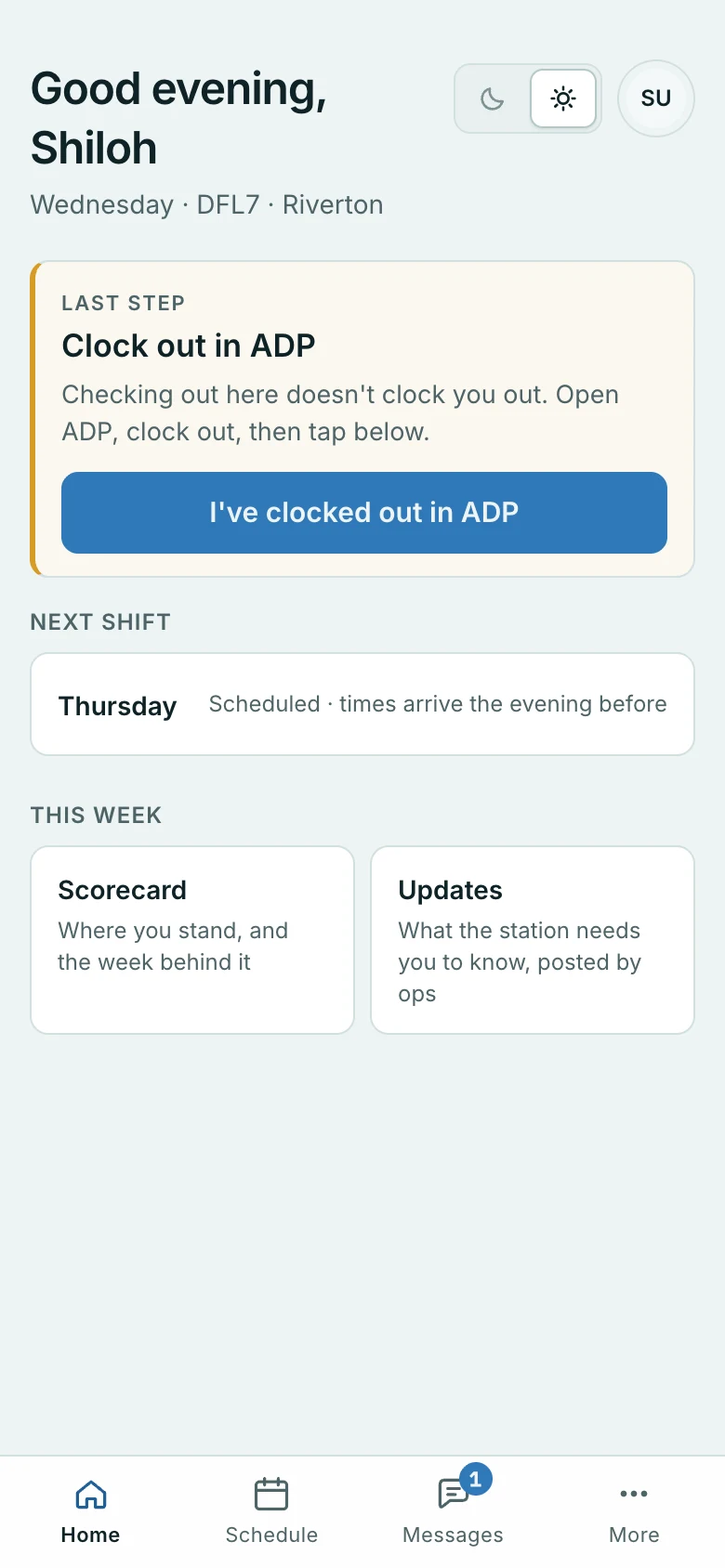
Checking out in the app — the van photos, the mileage, the keys — does not clock anybody out of payroll, and drivers leave the yard believing it does. So the moment a driver finishes their check-out, Home asks them to clock out in your payroll app.
Check-out lands on Home, and the first card reads Last step · Clock out in your payroll app, with one button: I've clocked out.
Ten minutes later, one push — only if the button has not been pressed.
It rings even late at night: quiet hours do not hold it, because a reminder at six the next morning is no use to anybody.
The press clears the card and stands down the push if it has not gone yet.
The card waits up to eighteen hours, and names the day when it is yesterday's.
Settings › Payroll app
Name the app your drivers clock in and out of — ADP, Paycom, Gusto — and the card and the push use that name. Leave it blank and nobody is asked; a new portal starts blank.