Owner · once · 6 min read
Your first week
Your portal arrives empty on purpose. Nothing is guessed about how you run your station — your shifts, your waves, your vans and your people are all yours to type, and this is the order that gets you to a board your drivers can read on their phones, usually inside a day.
What you already have
Before you do anything, your portal has been built and some of it is already filled in. Each station you asked for exists, and each one came with the parts that are the same at every DSP:
- Absence types — PTO, unpaid, no-call-no-show, and the rest. Edit the list later if your words differ.
- Roster statuses — Roster, Backup, OTR trainer, rescue, and the others a day needs. Each one carries its own colour, and you can add your own.
- Service rules — DEF every 3,000 miles, oil every 7,000, tyres every 8,000. Change the numbers to your own; they are yours, not Amazon’s.
- Check-in and check-out forms, with the walk-round photo positions already laid out.
- A Broadcast channel per station, for the notice that goes to everybody.
What is deliberately not there: your shifts, your waves, your ops team, your vans, your drivers and your permanent schedule. Those are the six things below.
Day one, in order
Each step depends on the one above it, so the order is not a suggestion. Somebody who knows how the station runs should do the first two; the rest can be shared out.
Open your emailed invite and choose a password.
The link is good for 24 hours. If it has gone stale nothing is broken — ask for another one, or have us send it again. You land on your own home page, which will be mostly empty and is meant to be.
Type your shifts and your waves.
Settings › Shifts and Settings › Waves. A shift is the paid window a driver is on the clock for (Shift 2, 10:55–20:55). A wave is the dispatch time they actually leave (Wave 1, 11:05). They are not the same thing and a driver on Shift 2 can be in Wave 1 — almost nothing else works until both lists exist, because the board, the schedule and the drivers’ day sheets all read them.
Set the station’s load time, and its line-up lanes if it has them.
On the same Waves screen. Load time is the minutes between a route’s planned departure and the wave it belongs to — 20 minutes at one of our yards, 25 at the other — and it is how an imported route sheet works out which wave a route is in. If your yard directs drivers into lettered lanes, type the letter on each wave and it appears on the driver’s day sheet; leave it blank and nothing is drawn.
Add your ops team and decide what each role can reach.
Users › Members to invite people, Users › Roles to set what each role may see and edit. Start with your Ops Manager and your dispatchers; you can widen access later in one press. There is a guide for this below.
Install the Cortex sync extension in the dispatcher’s Chrome.
This is what brings Amazon’s routes, roster, fleet, vehicle checks and hours in. It takes about two minutes and there is a guide for it below. Do it before you type a single driver or van — the sync will fill most of both in for you.
Check the roster and the fleet against Amazon’s.
Once the sync has run, People and Fleet each end with a panel comparing Amazon’s list to yours, with a button for each difference. Most of your roster will already be there. Anyone Amazon does not know about you add by hand; a van needs its VIN and the sync fills in the rest.
Build the permanent schedule.
Schedule › Permanent schedule. For each driver, the days they normally work and their usual wave. This is the one piece of typing nobody can do for you, and it is what every future week is generated from — so a weekly roster stops being a weekly job.
Generate next week and publish it.
Schedule, pick the week, Generate from pattern. It starts as a draft only the ops team can see. Read it, fix it, then Publish this week — publishing is what puts it on your drivers’ phones. Do two or three weeks while you are there.
Build tomorrow’s board and send it.
Dispatch, pick the day, Build the day. It lays the rostered drivers against Amazon’s route demand and puts each driver on their van. Settle the gaps, then Send shift times — that is the press that rings phones. Your station is live.
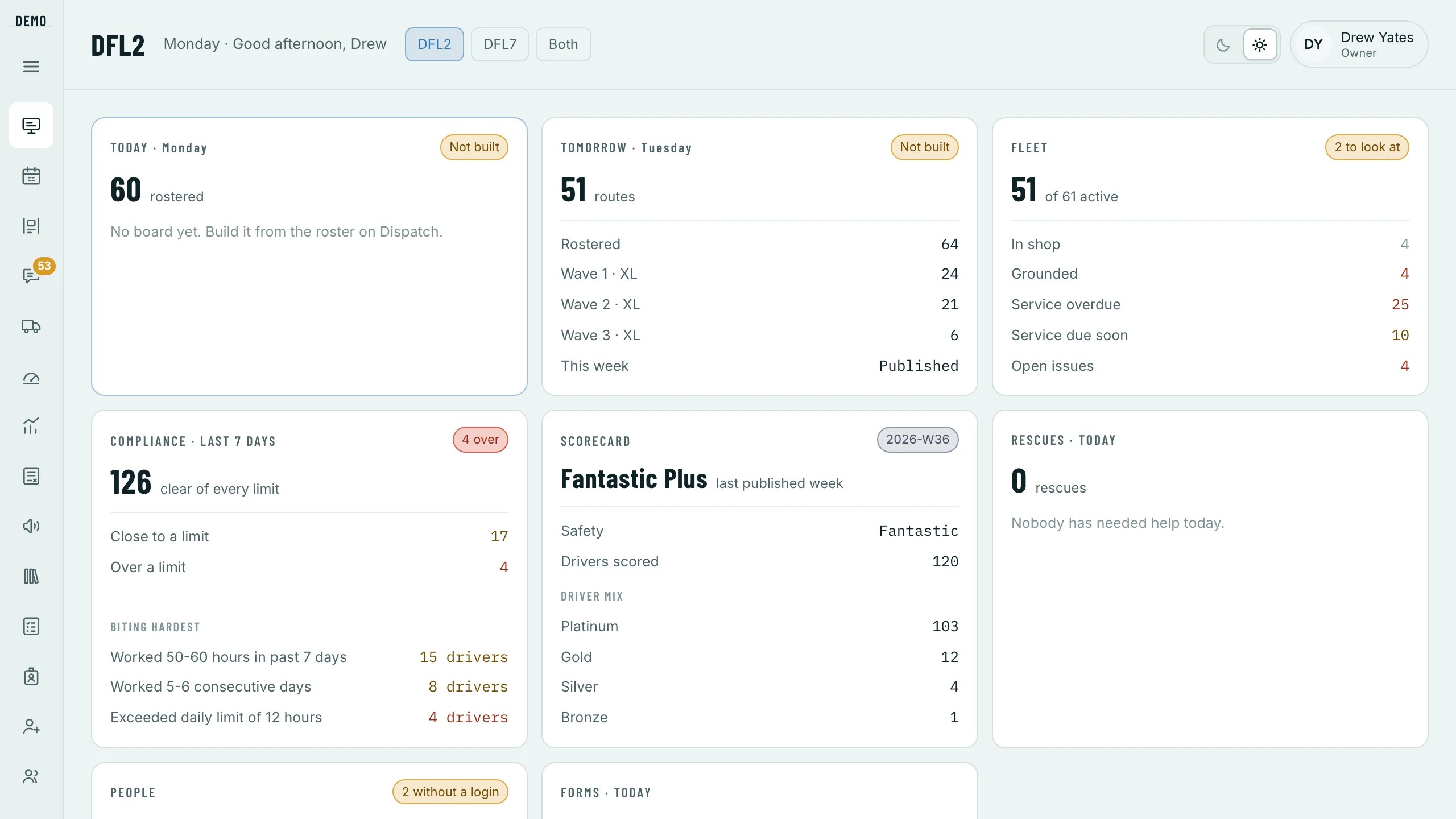
The first week, after day one
Once a board has gone out, the rest is worth doing in the first week rather than the first hour:
- Invite your drivers
- From each driver’s own profile in People, not from Users. See the drivers’ guide below.
- Turn on notifications
- Everybody, on every browser and phone they use — it is asked for per browser. Your account menu has the switch.
- Set your van benches
- Fleet › a van › the bench. Who is first, second and third call on each van. The board reads it every morning.
- Check your service clocks
- Fleet › Settings. Our intervals are a starting point, and the first van you enter a mileage for will tell you whether yours differ.
- Pick a photo retention
- Fleet › Settings. How long walk-round photos are kept before they are deleted. There is no wrong answer, but there is a bill.
- Set up hiring mail
- Only if you are hiring. Tell us which address it should come from and we prove it delivers before you send anything.
What we do with you
Setting up is not a form you are left alone with. Your stations, your addresses and the first Owner login are made before you see the portal, and we stay on the line for the first board. If something in the list above does not match what you are looking at, ask — it is more likely to be us than you.